

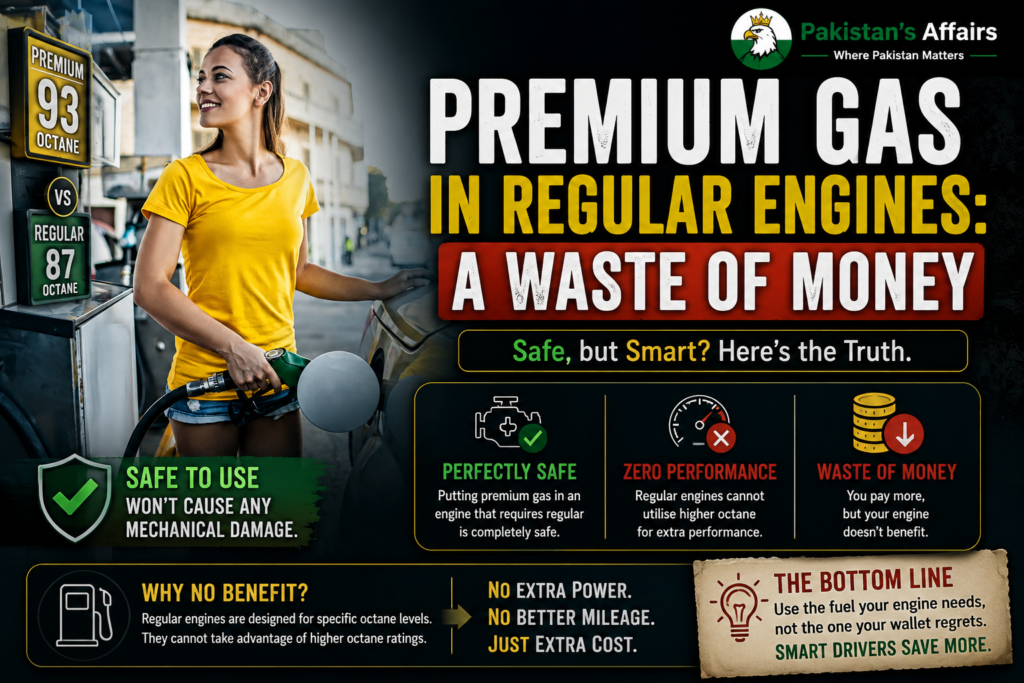
Putting premium gas in an engine that requires regular maintenance is perfectly safe. Further, it won’t cause any mechanical damage to your car. However, it provides zero performance benefits and is a waste of money. This is because regular engines cannot utilise the higher octane rating.
The Reality of High-Octane:
Giving up your daily latte macchiato is one way to help balance your finances, according to personal finance gurus. The small things are beneficial. such as not overspending on the beverages your automobile consumes.
The most expensive petrol you can often purchase is premium-grade petrol, which costs around 50 cents more per gallon than ordinary petrol. Because only 18% of newly manufactured automobiles in the US require it. Therefore, using high octane has no benefits for the remaining 82% in terms of performance, fuel economy, or emissions control.
It’s not a minor issue. According to AAA estimates, drivers squander almost $2 billion annually by purchasing more octane than their cars need, even though they may believe they are providing a gift to their cherished vehicles. Instead, give finer floor mats with gift wrapping.
Similar to wine, a higher price does not guarantee a better level of enjoyment. As always, the automaker gave the fundamental advice to adhere to the fuel requirements specified in the owner’s manuals. High-octane fuel may be advised but not required, leaving the motorist to make that choice.
Read More: Mercedes ‘Apology’ After China’s Consumer Gripe Goes Viral
The Octane Clarified:
Nevertheless, you should purchase a premium if the vehicle needs one in order to maintain the engine’s optimal performance. The fuel’s resistance to detonation is indicated by the octane rating that is shown on the pump. In the cylinders, combustion has gone uncontrolled. You might hear pinging or banging, particularly the sound of stones rattling in a tin can, in automobiles manufactured before 1980.
Recently, manufacturers have produced engines with higher internal operating pressures in pursuit of more power and economy. Thus, they achieved it by increasing the compression ratio, installing a supercharger, a turbocharger, or both.
A Caution About Octane:
In certain circumstances, premium petrol with an octane value of 91 or above must be formulated. We need to ensure that we maintain control over the cylinders’ combustion. Engineers refer to this uncontrollable kind of combustion as detonation, and the higher the octane, the more effective it is at preventing it. The objective is to use the spark plug alone to ignite the fuel mixture. to avoid detonation rather than from the heat within the cylinder. However, it can do significant harm to high-performance engines.
An engine built to run on 87-octane petrol has less chance of a detonation since it is not as strained. Therefore, utilising premium does not benefit it. The additional five dollars or more paid on premium for every tankful in those vehicles is
“It’s okay to choose the lower grade if it doesn’t say ‘required,'” stated Jason Kavanagh, senior automotive test engineer at the car-shopping website Edmunds.com. However, you should do your own research on the economics, he continued.
The Idea of Lower Octane Gas:
One reassuring fact is that, even if a premium is needed, using a tankful of lower-octane petrol in an emergency is unlikely to harm the mechanics. Due to a small piece of technological magic known as a knock sensor. This sensor was first used in computerised emissions control systems in the 1980s. However, when the system adjusts for the lower octane, performance will decrease.
The Edmunds website has a list of vehicles from 2012 to 2018 that need premium petrol. The 18% of 2018 vehicles that need a premium have remained mostly stable over time. Experts suggested that sixteen per cent of autos are premium, a number that has increased during the past ten years. Due to increased turbochargers and superchargers, as well as higher compression ratios.
Say Goodbye to Winter Gas:
The transition to summer petrol mixes is another cost problem that drivers will soon have to deal with. Yes, much like your clothes, petrol is seasonal. The time of the changeover and the chemical composition of the fuel will also differ, much like the weather across the United States.
The summer petrol compositions, which may be delivered as early as this month, are the core idea. However, they designed the measures to lessen volatility, and the majority of locations must implement them by June 1. The gasoline’s Reid vapour pressure is a measure of how easily it evaporates (and adds to ground-level pollution). In contrast, winter mixes must evaporate more readily to start more quickly in cold weather; they reappear after September 15.
Drivers can’t really avoid paying an additional cent or more per gallon for summer petrol. However, it depends on where you are. Consequently, due to the blend’s components and the necessity of closing refineries during the switchover. There is a little bit more vigour in the summer chemistry. Thus, you could notice a slight increase in fuel efficiency.
Higher Ethanol Levels:
This year, there’s another wrinkle you should be aware of.
For a long time, the maximum amount of ethanol allowed in summer petrol mixes has been set at 10%. Thus, E10 is the standard amount found in the majority of petrol sold in the United States. This is due to the comparatively increased volatility of ethanol. In order to let the ethanol content increase to 15%, or E15, the E.P.A. is seeking to eliminate the prohibition on greater percentages in summer petrol.
As a result, drivers will need to pay more attention to the indications on the petrol pump.
The E.P.A. only permits the use of E15 in light-duty cars manufactured after 2001. The EPA has not authorised the use of E15 in motorcycles, boats, lawn mowers, off-road small engines, or cars manufactured before 2001.
The 2019 Model Cars and E15:
More significantly, manufacturers permit E15 usage for 93% of 2019 model cars (by sales-weighted volume). Some automakers specifically forbid you from filling up with it, according to the Renewable Fuels Association. New cars from BMW, Subaru, Mitsubishi, Volvo, Mercedes-Benz, and Mazda. The manufacturers have not authorised them for the E15. Therefore, vehicles manufactured by Fiat Chrysler, Hyundai, Kia, and Volkswagen from model years before 2019 could also not be eligible for E1. You will thus need to retrieve the owner’s handbook once again.
Depending on the manufacturer, using E15 may violate the engine’s warranty. It’s wise to be mindful of what you’re putting into the tank as usual. Furthermore, it’s possible that E15 won’t show up at your petrol station this summer. Due to floods in the Midwest, ethanol refineries have been shut down.
The Bottom Line:
Octane (Regular vs. Premium): Putting premium gas in a car that only requires regular is completely safe and causes no mechanical damage. But it offers zero benefit to power or cleanliness. It is a pure waste of money. Because a regular engine cannot utilise the higher stability of premium fuel.
Ethanol (E10 vs. E15): The ethanol content is a structural compatibility issue, unlike octane. Therefore, using E15 (15% ethanol) in a car that isn’t specifically authorised. In fact, the manufacturer might seriously corrode fuel system parts and violate your warranty.
The Best Practice: Always follow the exact specifications printed on your fuel door or inside your owner’s manual. But sticking to the minimum required octane saves you money. Respecting maximum ethanol limits protects your engine from damage.
The Original Article Published on “The New York Times“: Putting Premium Gas in an Engine That Requires Regular?

На этом веб-сайте есть возможность обнаружить много увлекательных статей.
Здесь доступны различные обзоры на важные вопросы.
Всякий посетитель сможет найти что-то интересного и обогатить свой багаж знаний.
Публикации постоянно обновляются, чтобы посетители всегда располагали доступ к самой новейшей подборке.
https://sakhaday.ru/news/vmesto-nadoevshih-makaron-gotovlyu-alio-olio-i-peperonchino-vsego-15-minut-i-uzhin-gotov