


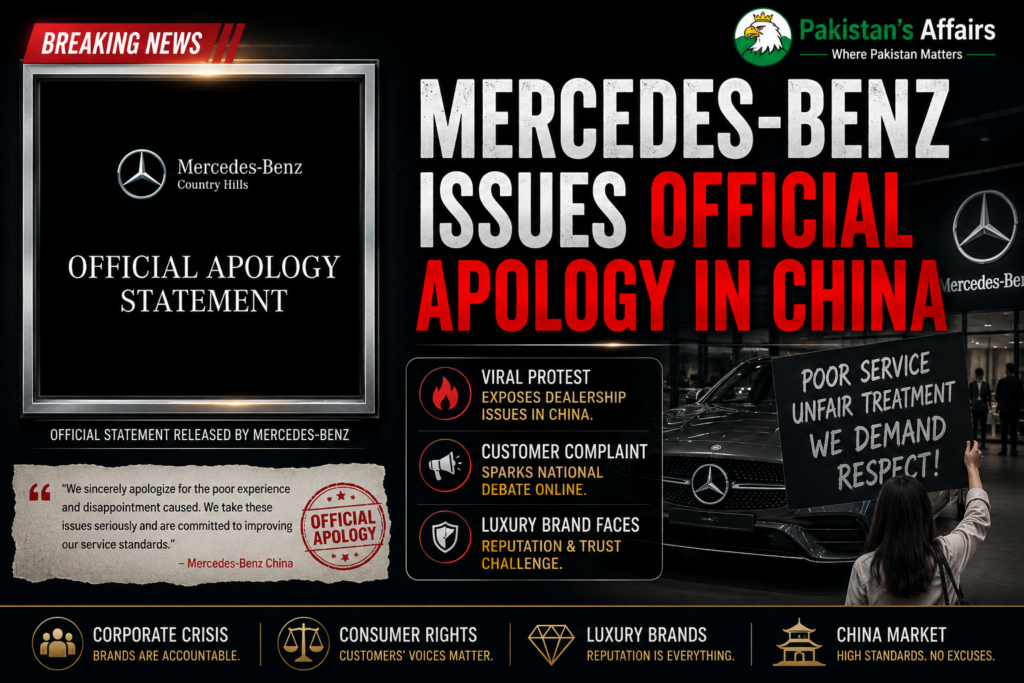
Mercedes-Benz issued an official apology! After a viral video of a Chinese consumer staging a protest at a showroom that exposed poor dealership service in China. But the viral video sparked widespread national outrage. That’s why the incident shed a massive public spotlight on the high-stakes friction. This friction is between global luxury brands and increasingly vocal Chinese consumers.
An Unknown Woman and Mercedes:
Mercedes-Benz, the massive German automaker, issued an apology on Tuesday for the experience of a Chinese vehicle buyer. The buyer claimed that a widely shared video featured an authorised dealership that infuriated customers.
The woman, whose identity has not been disclosed. She claims that after buying a brand-new Mercedes from an authorised dealer in the northern city of Xi’an. After purchasing, she later found out that it was spilling oil on the showroom floor.

She was shown in a video sitting on a car’s hood in the dealership. She also furiously accused salespeople of ignoring her requests for a refund.
In subsequent interviews with the media, the woman also claimed that the dealership coerced her into taking out a loan with exorbitant costs. Even though she had initially intended to pay cash for the vehicle.

Read More: Macron vows to rebuild Notre-Dame in 5 years
A Board Member of Daimler:
Hubertus Troskas, a board member and head of China operations for Daimler, the parent company of Mercedes, stated, “We deeply regret whatever happened.” “Speaking to reporters on the first day of the Shanghai Auto Show, he continued, “We have reached an agreement with the customer, and she will continue to be a Mercedes customer.”
However, the furious buyer stated in a Chinese media interview that he published on Monday. She would not accept any compensation offer from Mercedes because she wanted consumer protection authorities to thoroughly look into the issue first.
Daimler and the Xi’an administration have already declared investigations.
The Dealership Promised to Fix The Leak:
“We do not endorse this. On the first day of the Chinese car show, Troskas declared, “We follow the law. We want all of our dealers to follow the letter of the law and the ethics of our brand because there is good consumer protection in China,” he stated. We must apologise. That hasn’t been handled appropriately.”
The dealership allegedly promised to fix the leak before installing a new engine when the woman asked for a refund.
Chinese internet users have responded to her complaints with a plethora of encouraging remarks, many of which share their personal consumer horror tales.
Mercedes-Benz Issued An Apology:
The story is the most recent in a string of incidents that demonstrate the influence of Chinese internet users on international businesses.
Mercedes-Benz issued an apology last year for “hurting the feelings” of the Chinese people after using a quotation from the Dalai Lama, an exiled Tibetan spiritual leader who Beijing demonises as a separatist, on its Instagram account.
Last year, Dolce & Gabbana, an Italian fashion label, apologised to Chinese customers after popular Chinese e-commerce sites removed their merchandise. An Instagram post sparked outrage, especially since people deemed it disrespectful to Chinese culture.
Marriott Hotel Chain’s Website Blocked in China:
Additionally, officials in China blocked the Marriott hotel chain’s website after a customer survey identified Taiwan, Tibet, and Hong Kong as distinct nations, infuriating Beijing. Marriott changed the text and expressed regret.
Global automakers have assembled for the Shanghai Auto Show amid a rare decline in sales in the biggest automotive market in the world. Several trade and economic concerns caused this decline.
The Bottom Line:
A single viral video can instantly bypass corporate PR armour and force immediate executive-level apologies. Also, a foreign luxury brand remains highly vulnerable to swift. This is because of widespread consumer boycotts in their most profitable markets.
The scandal opened a Pandora’s box regarding hidden dealership fees. It’s also forcing nationwide regulatory crackdowns on auto lending. Therefore, Chinese buyers are no longer passive; they expect global customer service standards to match premium global pricing.
The Original Story Published on Asia One: Mercedes ‘very sorry’