


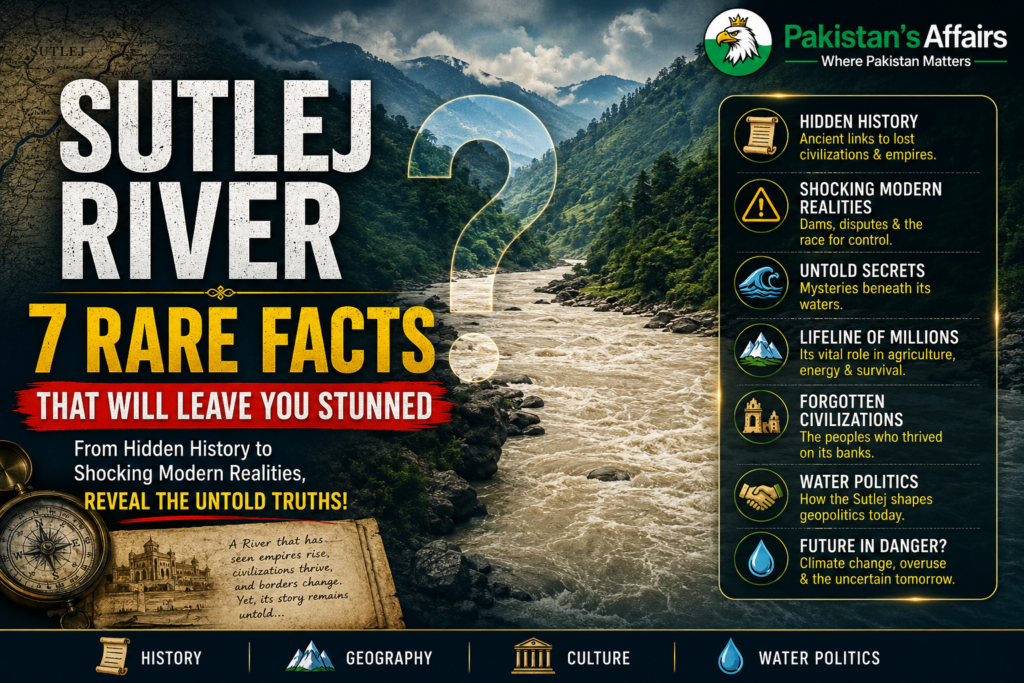
A deep dive into the longest river in Punjab, from its sacred Tibetan origin to its endangered future! Discover 7 rare Sutlej River aspects that will leave you stunned. From hidden history to shocking modern realities, reveal the untold truths.
The River of Sutlej – The Longest River of The Punjab:
What thing comes into your mind when you say ‘Punjab’? Most people imagine golden wheat fields and the scent of mustard in bloom. Maybe the traditional sound of the dhol drums of this region jolts your mind. But only a few people stop to think about the river that makes all of it possible in every aspect. But the fact is that the Sutlej River is the longest of Punjab’s five legendary rivers. This is because it has been flowing through this land for thousands of years.
Although it’s carrying glacial water from one of the most sacred spots on Earth all the way to the plains of Pakistan. And yet, most people know almost nothing about it. What follows are seven aspects of the Sutlej that most geography textbooks quietly skip. But the aspects that are rare, surprising, and in some cases deeply unsettling.

Introduction of The River:
Before we begin this post, let’s ground ourselves. Where is the Sutlej River situated, really? So, the Sutlej River travels through three nations. It begins in Tibet, China, and then flows through Himachal Pradesh, India. Further, the river flows across Pakistan and Punjab before joining the Indus Valley and entering the Arabian Sea. On the other hand, it is around 1,550 km long altogether. Out of all the five rivers that run through Punjab, it is the longest and most eastern. Indeed! Given its name, Punj-ab, it literally flows into the “Land of Five Rivers.”
That is the geography lesson. Now for the parts that will genuinely surprise you.
Hello friends, respectful elders and brothers! As you know, we cover the rivers of Punjab in this series. You can also check out our last article on the Ravi River. Let’s move on to the Sutlej River!

Rare Aspect # 1 – The Origin of The River:
Its Birthplace Is One of the Most Sacred and Haunted Lakes on Earth!
The fact that if you ask anyone about the Sutlej River’s origin. He will likely shrug. But the answer is extraordinary. Although the Sutlej River does not begin in the Himalayas, as the other Indian rivers do. Yet, it begins far beyond them on the high Tibetan Plateau at an altitude of approximately 4,600 metres (15,000 feet) above sea level. Originally, it begins near a lake called Rakshastal.
Sutlej River Origin – Key Fact
Lake Rakshastal is located in the Tibet Autonomous Region in China. Whether it’s Altitude is ~4,570 m (15,000 ft). Meanwhile, its original Neighbouring landmark is Mount Kailash and the sacred Lake Mansarovar.
The Haunting Fact About The Beginning of The River
Now here is the part of our writing that definitely raises your goosebumps. Lake Rakshastal’s name literally means ‘Lake of the Demon’ in Sanskrit. This is because it sits side by side with Mansarovar Lake, where people believe this lake to be the holiest one in Hindu and Buddhist cosmology. According to ancient texts, Lord Brahma created the Mansarovar lake and made it the abode of divine purity. Rakshastal’s dark twin is the lake of Ravana’s meditations. This lake is associated with the demonic and the fearsome. While the two lakes lie within sight of each other. But these lakes are also separated by a narrow strip of land.
The Sutlej springs from the ‘demonic’ lake and flows into a continent. It is born in shadow, at the foot of a mountain worshipped by four of the world’s great religions. If there was ever a more mythologically loaded birthplace for a river, it has not been found.
The Geological Origin of The River
Geologists classify the origin of the Sutlej River as a glacial outflow from the Langqen Zangbo glacier, and people in Tibet know the river as Langqen Zangbo. ‘The Elephant River’, because of the thundering force of its early course. It travels roughly 400 kilometres inside Tibet before it even reaches India. Most rivers that supply Punjab are entirely Indian in origin. The Sutlej is not. It is a transboundary river from birth, carrying the melt of a Tibetan glacier down through one of the most spectacular mountain descents on the planet.
Rare Aspect # 2 – The Geography of The River:
It Is Called ‘The Red River’, and the Reason behind it is both beautiful and Alarming!
The Identity of the River
The Sutlej has many names. In Sanskrit, it is Shatadru — ‘the river of a hundred streams.’ In the Rigveda, it appears as Satadree. But in modern usage, it is simply the Satluj or Sutlej River. But rarely mentioned in formal texts that the people of Punjab have whispered for generations. There is one more name, ‘The Red River’.
This name is beautiful in one sense. When the Sutlej descends from the high Himalayas through Himachal Pradesh fields. The river’s water carries enormous loads of reddish-brown sediment. Additionally, this sediment is a fine iron-rich silt eroded from the Himalayan rocks. While in the morning, light stretches of the Sutlej can appear deep. Further, the river’s colour was burnished red-orange, especially after rain. Thus, early travellers wrote of the river’s ‘crimson complexion’. As it crashed through gorges near Kinnaur.
“The Sutlej’s rapid course with just the ideal volume of water makes it and its tributaries the ‘Power House of the Himalayas.”
Maps of India: The Geographical Reference
The Reality of The Red Colour
But the red in the Sutlej today is not only sediment. Downstream of Ludhiana, industrial and urban waste heavily pollutes the Buddha Nullah, a tributary. Thus, all the wastes merge with the Sutlej River at that point. The river undergoes a transformation that is nothing short of catastrophic. Water quality surveys have found that the Sutlej carries Class B water (moderately polluted) before this confluence. The water degrades to Class E water, completely unfit for human use, irrigation, or any purpose, immediately after. The red of chemical waste and industrial dye has joined the crimson of mythology.
The minerals from the Himalayas previously caused this river to become scarlet. But sometimes the Sutlej water runs red with the discharge of textile factories. While both shades of its water red are real. Only one of them is beautiful.
Rare Aspect #3 – The Ancient History of The River:
It Appears in the Rigveda. But its Sanskrit Name Means Something Extraordinary!
The Sutlej River is not merely old. It is one of the oldest named rivers in continuous human memory. It appears in the Rigveda. As one of the world’s oldest surviving texts, which was composed roughly 3,500 years ago. But under the name Shatadru, which translates from Sanskrit as ‘the river of a hundred streams.’ Its classical name Satadree echoes that ancient description even today.
The Sutlej Vedic Identity – Key Fact
Along with the rivers like the Ganges, the Yamuna, the Sarasvati, and three other rivers. While the Sutlej River is one of the Seven Sacred Rivers of Vedic geography, or Sapta Sindhu. As this river is one of the founding rivers of Indian culture is the Sapta Sindhu.
An Ancient Civilisation and The River
Before we proceed, give that some thought. As todays Sutlej River irrigates Punjab’s wheat fields as it passes via Ludhiana. But this river was hymned long before the priests did so, 35 centuries ago. Because it’s a fact that one of the important locations of the Indus Valley Civilisation is the Harappan city of Rupnagar (Ropar). On the other hand, this ancient civilisation is situated on the banks of this River. Additionally, archaeologists working at Ropar discovered items from 5,000 years of human occupation. Lastly, there is evidence that the Sutlej was the birthplace of civilisation long before recorded history.
The name ‘a hundred streams’ was not a poetic exaggeration. Before centuries of irrigation-driven diversion, the ancient Sutlej spread across the Punjab plain as a much wider, more braided river in dozens of shifting channels, nourishing the farmlands of what was then one of the most densely settled regions of the ancient world. The people who wrote the Rigveda looked at this river and saw a hundred tributaries gleaming in the sun. They were not wrong.
Rare Aspect #4 – The Geology of The River:
It Carved Through the Himalayas. Before the Himalayas Even Fully Existed!
Perhaps the most astounding geological truth about the Sutlej is this. Most people, including those who study it, initially find it difficult to believe.
The fact is that geologists categorise the Sutlej as an antecedent river. This also indicates that the river is older than the mountain range it traverses. This is because the Sutlej was already moving westward across the Tibetan Plateau millions of years ago. It’s also long before the current height of the Himalayas was attained. Further, the steady collision of the Indian and Eurasian tectonic plates caused the Himalayan mountains to rise. In comparison, the Sutlej continued to cut downhill. Additionally, it keeps going by dissolving the rising rock more quickly than the mountains could raise it.
Sutlej River Location – Full Journey
Rakshastal, Tibet (4,600m) → Tibet plateau (~400 km) → Shipki La Pass, Himachal Pradesh → Kinnaur gorges → Bhakra-Nangal → Punjab plains → Harike (meets Beas) → Pakistan → Chenab → Indus → Arabian Sea
The Ancient and Powerful Antecedent River of Punjab
One of the most breathtaking gorges on Earth is the outcome of this ancient intransigence. It is located close to Shipki La in the Kinnaur district. The Sutlej River cuts a steep gorge when it enters India. It is the areas where the granite cliffs rise hundreds of meters on either side that the river narrows. At the Shipki La Pass, the Sutlej drops from 6,608 meters to the lowlands. In a geological blink, it is also losing thousands of meters of elevation. Even yet, this river is not a calm one that meanders over mountains. But when the mountains came, this river would not budge. Because this river just cuts right through them.
Only three rivers in the Indian subcontinent are classified as trans-Himalayan antecedent rivers. Where the first one is the Indus River and the second one is the Brahmaputra River. While the last one Sutlej River. To share a category with those two giants tells you something. How just ancient and powerful the Sutlej truly is.
Rare Aspect #5 – Military History:
Empires Rose and Fell on Its Banks, and it once drew the Line Between Two Civilisations!
The Sutlej River runs along what is now the border between Himachal Pradesh and Punjab. But this river has made it one of the most contested frontier rivers in South Asian history. Because it did not just witness history. It shaped it.
The Sutlej served as the formal boundary between British India to the south and east for much of the 19th century. Where the Sikh Empire under Maharaja Ranjit Singh extended to the north and west. Although the river was not merely a geographical marker. Yet it was a political and military line that the East India Company was acutely aware of. The Sikh Empire defended it with one of the most formidable armies of that age, also.
“The Sutlej is one of the seven rivers of the Sapta Sindhu in Vedic geography. The Battle of Sutlej (1845–46) and Sobraon during the First Anglo-Sikh War took place along its banks.”
(Anantam IAS – The historical geographical reference)
The First Anglo-Sikh War (1845–46) originally saw soldiers fighting almost entirely along this river’s side. That’s why people also call this battle the Battle of the Sutlej. Furthermore, the battles like Mudki, Ferozeshah, Aliwal, and the decisive encounter at Sobraon are the most famous battles. Because all these battles were fought within a few kilometres of the Sutlej’s banks. Further at Sobraon, the Sikh Army’s collapse into the flooded, swollen Sutlej became one of the bloodiest episodes of the entire conflict. The river that had nourished the Sikh homeland for centuries swallowed thousands of soldiers in a single afternoon.
After the war, the Sutlej once again became a boundary, this time marking the extent of British annexation. The river had defined the edge of one empire, witnessed its defeat, and then quietly became the border of the empire that replaced it. Few rivers in history have been this politically consequential.
Rare Aspect #5 – Engineering on The River:
The river Powers Half of Himachal Pradesh, and it also Holds One of India’s Most Symbolic Dams
Famously, Prime Minister Nehru referred to all the dams as the “temples of modern India.” Particularly after India gained freedom in 1947. While the Bhakra Dam was deserving of the distinction. Engineers constructed this dam in Himachal Pradesh over the Sutlej. They finished the dam in 1963 as well. When they built it, it ranked among the world’s highest gravity dams. 226 meters above the riverbank lies a massive structure made of concrete.
- 1,325 MW: Bhakra Dam capacity
- 1,500 MW: Nathpa Jhakri Dam capacity
- 1,000 MW: Karcham Wangtoo Plant capacity
- Sutlej valley: 50% Capacity of Himachal Pradesh’s hydro potential from the Sutlej valley
Sutlej – A geopolitical Layer of India and Pakistan
The Sutlej valley alone holds about half of Himachal Pradesh’s total hydropower potential. The river’s entire estimated capacity in Himachal Pradesh is now 20,000 MW. The two main ones are the Karcham Wangtoo Hydroelectric Plant (1,000 MW) and the Nathpa Jhakri Dam (1,500 MW). Thus, these efforts greatly strengthen the system. Because of this, these projects are currently northern India’s greatest energy-producing river valley. because the Bhakra canal system provides irrigation water to Punjab, Haryana, and Rajasthan. The waters of the dams submerge millions of acres of agriculture throughout the Indo-Gangetic plain.
There is a geopolitical layer here, too. Under the Indus Waters Treaty of 1960, the Sutlej was allocated entirely to India along with the Ravi and Beas. This means India has the legal right to use every drop of Sutlej water before it crosses into Pakistan. India’s construction of extensive infrastructure on this river is both a development triumph and, in Pakistan’s eyes, a constant reminder of how dependent Pakistan is on India’s goodwill with the western rivers allocated to it in exchange.
Thus, the Sutlej is not just a river. It is a power grid and an irrigation network. While it’s also a geopolitical statement, all flowing in the same direction.
Rare Aspect #5 – The Crisis of The River:
The Supreme Court of India has sounded the alarm: the Sutlej is slowly dying!
This is the aspect that should shock you most of all. It’s a river that was hymned in the Rigveda, and it carved through the Himalayas before they finished rising. As it also powered India’s post-independence industrial ambition, it is in crisis.
The Supreme Court of India has expressed its deep concern about the deteriorating condition of the Sutlej River. The court described it as a historically perennial river now threatened by pollution and over-extraction. Ecological neglect also plays a part in this river’s destruction. The data is grim. But the river receives the discharge of hundreds of industrial units downstream of Ludhiana. The dyeing factories, electroplating units, and chemical plants all play a destructive role. Also, the untreated sewage from a city of over five million people.
Fact – Pollution Reality
Before the Buddha Nullah confluence near Ludhiana: Class B water (moderately polluted, treatable).
After the Confluence: Class E water is completely unfit for drinking, bathing, or irrigation.
The Sutlej effectively dies chemically at Ludhiana and is not meaningfully restored downstream.
The Pollution in The River
But the pollution is only part of this story. Because the Sutlej River faces an existential threat upstream that no factory or sewage pipe caused: glacial retreat. The Langqen Zangbo glacier in Tibet that feeds the river’s birth is melting at an accelerating rate due to climate change. In the short term, this may actually increase river flow as more ice melts. But in the medium and long term — within decades — the glacier that has fed the Sutlej for millennia will be substantially smaller. The river will lose its most reliable source of dry-season water.
The River is at Risk
There is also the Sutlej-Yamuna Link (SYL) canal is a proposed 214-kilometre channel that would divert Sutlej waters to Haryana, a project that has been mired in a decades-long interstate legal and political battle between Punjab and Haryana, reaching the Supreme Court multiple times. People are simultaneously asking the Sutlej to give more water while it receives less water from its sources and more pollution from its banks.
The river that people once called “the hundred streams” is gradually reducing to one: a slow, burdened, chemically compromised trickle through a floodplain that once cradled one of humanity’s oldest civilisations. That is the seventh aspect — and it may be the most important one.
The Bottom line:
The Sutlej River is more than simply a location on a map of Punjab. because it is a living repository of the most profound history of our subcontinent. Vedic hymns, Harappan cities, Sikh empires, colonial conflicts, and aspirations for independence are all examples. So, the language of water is used to write them all. The water that naturally flows to the sea from Tibet’s mountains.
It takes around three nations and five millennia of civilisation to locate the Sutlej River. One of the world’s most disputed, cherished, and threatened rivers is this one. Because the solution is never straightforward. You now understand why.
Sources:
Wikipedia: The Sutlej
Baritannica: Sutlej River | India, Punjab, Himalayas