


Rising communal tensions and failed negotiations with the British are the two main reasons behind this scenario. Afterwards, strong public support also played a crucial role in this great independent movement. The movement succeeded with the benchmark of Pakistan’s creation on 14th August 1947. This would also lead to the dead end of British rule on the Indian subcontinent.

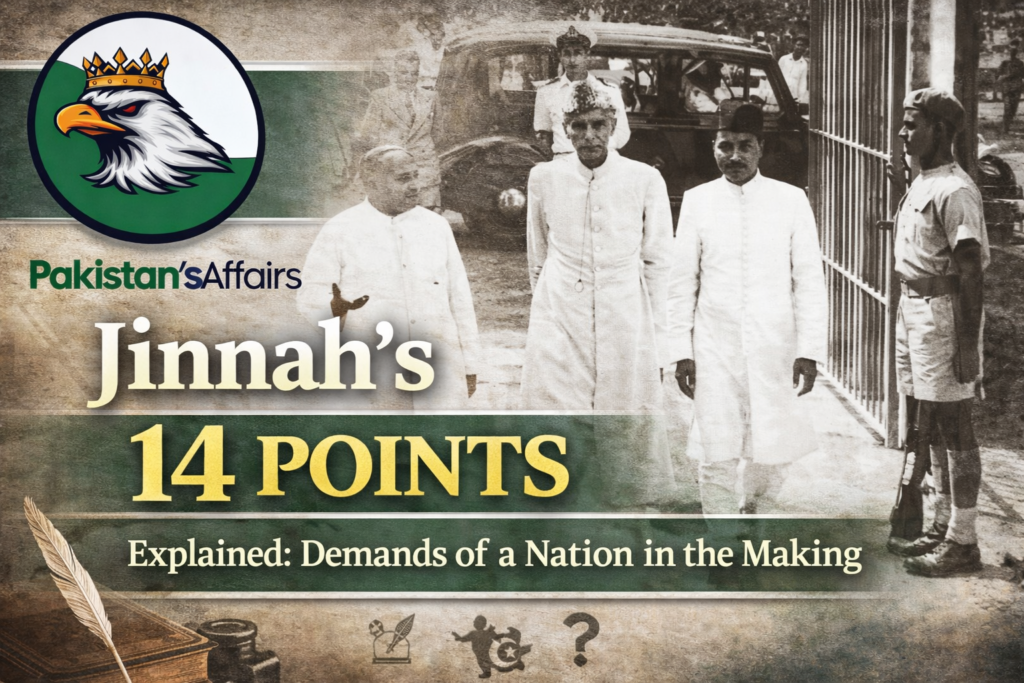
For the Pakistan Movement, Quaid-e-Azam Muhammad Ali Jinnah spearheaded a social and political campaign (1940–47). Thus, the All-India Muslim League’s only goal was to provide Muslims with their own country in the United India. But somehow, with the 1940’s Lahore Resolution, the movement reached its peak. Moreover, this famous resolution demanded an independent state for Muslims.
- Introduction – A True Story:
- The Roots Before 1940 – A Feeling of Loss:
- The Rise of Political Identity:
- 1937 Elections – The Turning Point:
- 1940 – The Lahore Resolution:
- War-Time Diplomacy (1942–1947)
- Political Victory and the Decisive Elections (1945–1946):
- 14th August 1947 – The Birth of Pakistan:
- A Unique Perspective – More Than Politics:
- Final Thoughts:
- Refferences:
Introduction – A True Story:
History doesn’t always begin with a loud revolution. Sometimes, it starts with the silent realisation and indicates that coexistence is no longer enough.
The Pakistan movement was not just a political demand for Muslims. It was the result of decades of frustration that later formed into a huge identity crisis. Yes! I am talking about the famous “Two-Nation Theory.”
In those days, there was growing chaos among Muslims on the subcontinent. Further, the chaos was that Muslims’ future required a separate direction in the United India. Therefore, this chaos turned into one of the most defining struggles in South Asian history. Thus, the struggle for Pakistan from 1940 to 1947 became true in a unique way.
A True Story
Long ago, my Pakistan Studies professor shared a short but mind-blowing story with my classmates and me.
Once, before partition, Pandit Jawaharlal Nehru (India’s first Prime Minister) invited Molana Liaqat Ali Khan (Pakistan’s First Prime Minister). Mr Nehru said, “Today, we’ll be eating from the same plate and prove that we are one nation.”
Liaquat Ali Khan quietly looked at the plate when the food was served. The rice on it had already been split into two separate portions.
He smiled.
Then he gently said, “Mr Nehru, look closely. This line between the rice — this is the Two-Nation Theory. You’ve already drawn the border yourself.”
He paused, then added, “We were never one nation. We were always two.”

The Roots Before 1940 – A Feeling of Loss:
Before you understand the Pakistani movement, you must go back to 1857. The British hugely blamed Muslims for the War of Independence. This situation led Muslims to political isolation and economic decline. That left Muslims with a deep sense of loss.
The British captured all the Muslims’ lands. Hindus took over all the government departments.
For years, there was confusion among all Muslims of the subcontinent. There was neither clear leadership nor the right direction overall.
Then Sir Syed Ahmad Khan, like the reformers, came. Who shifted Muslims’ mindsets in the United India? He encouraged Muslims to adapt to modern thinking rather than resist change blindly. He wanted every Muslim boy to get a modern education and rebuild their positions for a better future.
This wasn’t a political movement yet. It was survival.
I hope everything is OK with you guys! We cover the series, as you know. “Cripp’s Mission 1942.” Read our earlier post first if you haven’t already. We attempted to cover the historical era from the 1940s to 1947 (before independence) in our initial attempt.
Also Follow us on Link Tree
The Rise of Political Identity:
With the formation of the All-India Muslim League in 1906, everything began to change, especially in Dhaka. This was the first time that Muslims had a political platform, especially to represent their own interests in the United India.
There is no doubt that leaders like Quaid-i-Azam Muhammad Ali Jinnah once believed in Hindu-Muslim unity. So, the Lucknow Pact of 1916 showed some possibilities for cooperation.
But this unity didn’t last long. Because some events like:
- The Nehru report (1928)
- The Failure to Protect Minority Rights
- Increasing Communal Tensions
…starting to widen the gap between Hindus and Muslims all over India.
But it became clear in the 1930s. Because Muslims and Hindus were not just two communities overall. In fact, they were two different political, social and religious realities.
1937 Elections – The Turning Point:
The Government of India Act 1935 elections served as a wake-up call for Indian Muslims.
The 1937 provincial elections were a turning point for the Pakistan Movement. Even though the All-India Muslim League (AIML) did poorly in the elections. While the Congress administration that followed (1937–1939) served as a catalyst. This scenario turned the League from an elite political organisation into a widespread movement for a separate homeland.
Many Muslims felt excluded because Congress formed governments in several provinces. So, Congress’s policies were seen as biased. Also, their reports, especially the Pirpur Report (1938), highlight discrimination against Muslims.
Investigation Reports
- Pirpur Report (1938): The Pirpur report investigates atrocities in all Congress-governed provinces.
- Shareef Report (1939): Meanwhile, the Shareef Report focused specifically on Muslims’ injustices in the province of Bihar.
- Fazl-ul-Haq Report (1939): Mr Fazl-ul-Haq’s report entitled Muslims Suffering Under Congress Rule.
This was not for the first time. Thus, this period changed the whole narrative.
So, the main question was no longer about rights within India.
It became about the survival of Muslims in an independent state, not in United India.
1940 – The Lahore Resolution:
Everything changed, especially on 23 March 1940. This is because most historians believe the Lahore Resolution was a clear breakthrough in the Pakistani movement.
Eventually, the movement officially entered its “Pakistan” phase during the Muslim League’s annual session at Minto Park, Lahore. The League demanded states in India’s north-western and eastern zones (Muslim-majority areas). This resolution later became known as the foundation of Pakistan.
After this, the Pakistani movement now had:
- A clear vision
- A united leadership
- A defined objective
According to Chaudhary Rahmat Ali (Now or Never; Are We to Live Or Perish Forever?). This was a one-way ticket. So, this was a one-way forward point; there was no turning back at this stage.
War-Time Diplomacy (1942–1947)
The British sought Indian support during World War II. Thus, the British led to several failed constitutional proposals for Indian leaders. While the next seven years were intense.
Cripps ‘ Mission (1942): Sir Stafford Cripps offered “Dominion Status” after the war in this mission. He also stated that the British allowed the provinces to opt out of an Indian union. But Mr Jinnah rejected it as it did not clearly concede Pakistan. Somehow, the Congress also rejected the proposal for not offering immediate independence for the United India.
The Quit India Movement (1942): Eventually, Mr Gandhi launched the Quit India Movement in 1942. Meanwhile, this movement was an “open rebellion” against the British in United India. On the other hand, Muhammad Ali Jinnah countered this movement with the slogan “Divide and Quit.” Mr Jinnah feared extremely that immediate British withdrawal without partition would lead to the “Hindu Raj.”
Gandhi-Jinnah Talks (1944): These talks were held at Jinnah’s residence in Bombay. Meanwhile, these talks failed because Gandhi refused to accept Muslims as a separate nation. Because Mohan Das Gandhi wanted a united India to achieve independence first.
But none could resolve the core issue for Muslims. Because Muslims wanted a separate homeland where they were politically, socially and religiously independent.
Mass Mobilization
So, the struggle for Pakistan moved beyond the elite politics of United India. It became a mass movement:
- Students
- Workers
- Women
- Religious scholars
Therefore, every Muslim played a vital role in this movement for a better future.
Leadership of Jinnah
One man stood at the centre of all Indian politics. Yes! He was the one and only Quaid-e-Azam Muhammad Ali Jinnah.
He was a very calm, strategic and firm personality. Although he transformed the Muslim League into a powerful political force. Yet his demand was simple and consistent according to the situation:
“Muslims are a nation, and they deserve a nation.”
Political Victory and the Decisive Elections (1945–1946):
The end of World War II brought this huge movement to its peak:
- Simla Conference (1945): Lord Wavell’s plan totally failed for an interim government at the Simla Conference. This was because Jinnah insisted that only the Muslim League could nominate Muslim members all over India.
- 1945–46 General Elections: The Muslim League fought the 1945-46 elections on the only point: “Pakistan.” So, the League won all 30 reserved Muslim seats in the Central Legislature and 90-95% of Muslim seats in provincial assemblies. The Muslim League proved it was the major and sole representative of every Muslim in the United India.
- Cabinet Mission Plan (1946): This mission planned to group all the provinces into three autonomous zones in a political move. That was the last British attempt to keep India united. So, both sides initially accepted that proposal. But later on, the proposal collapsed after Jawaharlal Nehru’s comments. He regarded the Congress’s freedom to change the plan once in power.
The Famous Charter of the All-India Muslim League in the General Elections 1945-46:
If Muslims want it, then Pakistan should be made; otherwise, the demand for Pakistan should be ignored!
The 1945-46 elections proved the strength of Pakistan’s demand over India. The Muslim League won overwhelmingly in Muslim-majority areas. Because the majority of Muslims stood behind the Muslim League. So, there was no obstacle left in the way of Pakistan!
This was the final signal.
The British realised that they could no longer hold the whole of India together.
14th August 1947 – The Birth of Pakistan:
Pakistan has emerged as an independent state in the world portrait. After years of political struggle, negotiations, sacrifices, and political moves, the dream became true.
3rd June Plan: The last Viceroy, Lord Mountbatten, announced the partition of India into two sovereign dominion states (India and Pakistan). While the British Parliament passed the plan in July 1947. Thus, the 3rd June plan was immediately implemented through the Indian Independence Act 1947.
Radcliffe Award: Sir Cyril Radcliffe drew the boundaries between India and Pakistan. Despite his criticism, Mr Jinnah accepted the award in order to secure independence. Mr Jinnah also highlighted that it was “unjust” to award Muslim-majority regions to India (like Gurdaspur and portions of Bengal).
Independence: Pakistan emerged as a sovereign state on August 14, 1947, in world history. Muhammad Ali Jinnah became Pakistan’s first governor-general. On the other hand, Mr Liaquat Ali Khan became the first Prime Minister of Pakistan.
But as we all know, independence comes at a huge cost:
- The history witnessed the biggest ‘Mass migration’ on Earth.
- Communal violence everywhere
Although human suffering was on an unimaginable scale. Yet, the goal was achieved despite the pain.
A Unique Perspective – More Than Politics:
In my opinion, everything that happened before and after this movement was a purely different scenario. Beyond the high-level politics of treaties and constitutional plans. But the Pakistan Movement (1940–47) was the Indian Muslims’ profound social and cultural transformation. It wasn’t just about a quest for a new map of the world. But it was an assertion of a distinct civilisation that sought a “sanctuary where faith could breathe.”
The Pakistan movement is often told as a political story. But at its core, it was something deeper.
It was about:
- Identity
- Security
- Self-respect
The right to shape one’s own future! It was not just leaders who negotiated politics in huge halls. But it was a totally different thing that millions of people believed in an idea.
Final Thoughts:
The struggle for Pakistan was not a sudden nor an accidental situation. In the vice versa, over a century and many decades had built this reality step-by-step. It was a tale of loss to awareness, from awareness to unity, from unity to action and then the final execution. As someone said:
“It’s a narrative of a century, not a saying of two or four years.”
This is a vision that turned into reality between 1940 and 1947, and it wrote a totally different story of our subcontinent.
And at the end, it proved only a simple truth:
Nations are founded via conviction, hardship, and unflinching determination; they are not made overnight. All I have to say is that!
Refferences:
Wikipedia – Pakistan Movement
A book “Dimensions of Pakistan Movement” by Muhammad Munawwar
A Book “2 Men and The Pakistan Movement” by Andreas Rieck