

Mend and maintain harmony. However, the compliments were consistently a bit too overwhelming for sixty-five years. However, somewhat excessively convenient. Look closely, and you find three dark secrets buried beneath the diplomatic handshakes. Secrets that have quietly shaped and now threaten the fate of over a billion people.
Background of the Indus Waters Treaty:
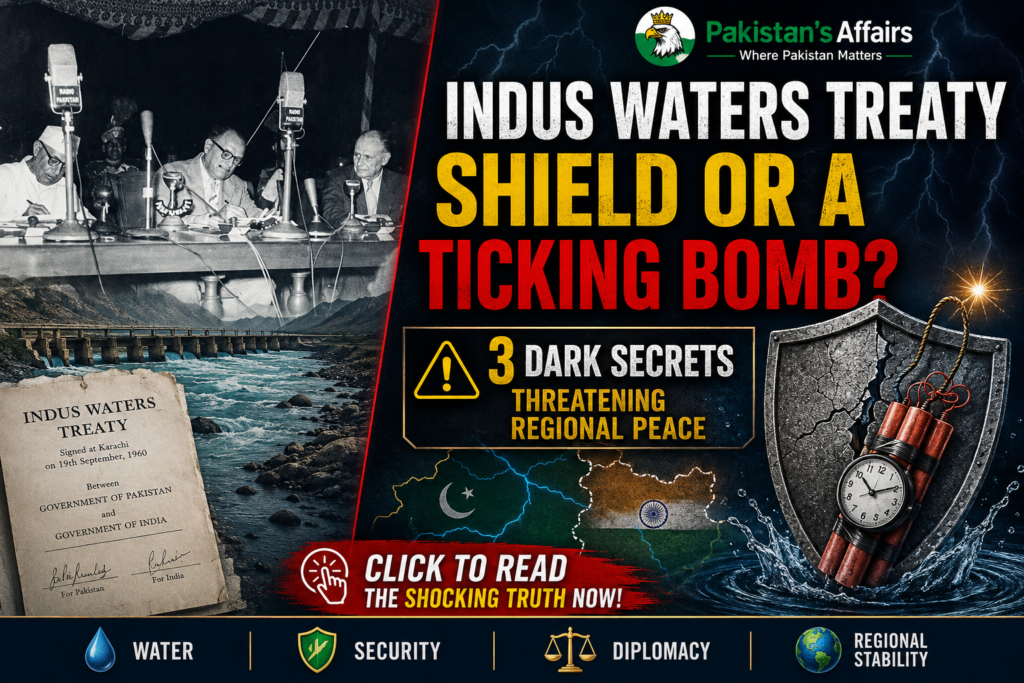
On a warm September morning in 1960, Pakistani President Ayub Khan and Indian Prime Minister Jawaharlal Nehru sat side by side in Karachi. Because they wanted to sign a document that the World Bank had spent nearly a decade crafting for both countries. Yes! This was the famous Indus Waters Treaty that divided the six rivers of the Indus basin into two countries. Three rivers for India and three for Pakistan. But both men called it a new dawn. Journalists wrote glowing columns. Diplomats called it a template for global peace.
They were not entirely wrong. The treaty did survive three wars and countless small provocations. Meanwhile, dozens of diplomatic crises occurred over six decades. But the waters kept flowing while the guns occasionally fired. By the standards of South Asian geopolitics, that is nothing short of extraordinary.
But extraordinary is not the same as fair. Or honest. Or safe.
The Real Fact of The Treaty:
There is nobody at that signing ceremony who wanted to say out loud. Because beneath that celebrated treaty lay truths. Additionally, in April 2025, 26 tourists were killed in a terrorist attack in Pahalgam in Kashmir. Therefore, India finally cracked the silence. However, there are so many question marks on that attack still today. Whether it was a drama or something else, no one knows. But India announced it would suspend the Indus Waters Treaty. They also placed it “in abeyance with immediate effect.” The parties disputed the treaty for the first time in its history. They halted it.
Greetings, brothers, respected elders, and friends! As you know, we cover the history of Pakistan these days. You may view our most recent article on Ravi Rivers History, if you haven’t previously. Now let’s discuss the historic Indus Treaty!
The world scrambled to ask: What is the Indus Waters Treaty really? Why did it just collapse after 65 years? And what were those uncomfortable truths everyone had been politely ignoring all along?
Here are the three dark secrets they never put in the textbooks.
1st Dark Secret:
India Signed Away 80% of the Water and Knew It Was Unfair
- 80% Water share is given to Pakistan.
- 20% Water share retained by India.
- 39% India’s share of the Indus basin.
Behind The Dark Secret
All students in South Asia learn that the Indus Waters Treaty represented a just agreement between the two nations. But the numbers tell a very different story.
According to the treaty, Pakistan took control of the three western rivers: The mighty Indus River itself, 2ndly the Jhelum River, and the Chenab River also. Meanwhile, India received control of the three eastern rivers: The historic Ravi River, the Beas River, and the Sutlej River. Although it sounds balanced, especially on paper. Three rivers for each country. A clean and elegant split.
Except that the rivers are not equal. Not even close. Pakistan’s three western rivers carry the overwhelming bulk of the Indus system’s total water. The result: Pakistan received approximately 80% of the water. Even though it controls only about 47% of the Indus basin’s geographic area. India is the upstream nation that actually sits at the source of much of this water. India also walked away with barely 20% despite containing 39% of the basin.
“We purchased a settlement, if you like; we purchased peace to that extent, and it is good for both countries.”
(Prime Minister Jawaharlal Nehru, in Parliament, explaining India’s concessions under the treaty)
Nehru’s Point of View:
That quote is startling when you sit with it. Nehru didn’t pretend the deal was fair. He called it a purchase. India, he admitted, was trading water for peace. The hope was that generosity would buy goodwill, and goodwill would eventually dissolve the enmity between the two nations born from one bloody partition.
It didn’t. Pakistan accepted the water and continued its support for cross-border militancy in Kashmir for decades afterwards. A grievance that India would carry quietly into every future conversation about the treaty. Pakistan never honoured the water-for-peace bargain, at least in India’s reading of history.
The fact about River Waters:
Worse still, India couldn’t even fully use its 20%. On the western rivers, authorities allocated to Pakistan and India permitted only limited “non-consumptive” uses: run-of-the-river hydropower, navigation, and limited irrigation. Any storage project required Pakistani approval, and Pakistan objected to almost everything. India has managed to develop barely a fraction of the roughly 30,000 megawatts of hydropower potential that even its restricted usage rights could theoretically generate.
For India’s farmers in Jammu and Kashmir, this translated into decades of underserved irrigation. It meant expensive delays and repeated project shutdowns caused by treaty disputes. Especially for India’s energy planners. For instance, the authorities redesigned the 1978 Salal Hydroelectric Project after sustained Pakistani objections. But the changes that ultimately undermined its operational efficiency. India simply shelved the Tulbul Navigation Project on the Jhelum after suspending work in hopes of improving relations. Those hopes faded. The project stayed shelved.
The Reality of the 1st Secret:
The first dark secret, then, is this: the Indus Waters Treaty was never truly fair to India, and the architects of the deal knew it. The “peace” it purchased came at a price paid entirely by India’s farmers, engineers, and energy planners. While Pakistan’s three rivers flow on, largely untouched and uncontested.
2nd Dark Secret:
The Treaty Has No Clause for Suspension – Which Means Nobody Knows What Happens Next
Here is something that most people don’t realise when they hear about the suspension of the Indus Waters Treaty: the treaty itself contains absolutely no provision for suspension. Not one line. Not a paragraph buried in an appendix. Nothing.
When India declared the treaty “in abeyance” in April 2025, it was using a legal concept that the treaty’s own text does not recognise. India’s justification that Pakistan’s support for terrorism constituted a material breach of good faith. That was a legitimate argument in the broader framework of international law. But the treaty mechanism itself has no off switch. No pause button. No emergency brake.
The Court of Arbitration had been looking into disagreements about the Ratle hydropower project and India’s Kishanganga project separately. The court also weighed in swiftly. In June 2025, it ruled that the treaty does not provide for unilateral abeyance. They also reaffirmed their own jurisdiction over the water disputes. So, the court is directly pushing back against India’s position.
“The treaty does not provide for unilateral abeyance.”
(Court of Arbitration. In a supplemental award for its competence in June 2025)
The Reality of the 2nd Secret:
This is the second dark secret, sixty-five years after the treaty was signed. Although nobody actually knows what happens when one side decides to stop honouring it. Yet, the World Bank brokered the treaty and continues to administer the treaty, which finds itself paralysed.
The dispute resolution mechanism was written into the treaty. So, the permanent Indus Commission, then the Neutral Experts, then the Court of Arbitration. They were all designed for technical squabbles about dam heights and water flows. They never designed it for the moment when one country decided that the entire framework was being exploited in bad faith.
| Major Dates | Major Occurrences According To The Treaty |
| 1960 | Treaty signed. Permanent Indus Commission established for regular data exchange and site inspections. |
| 2016 | Uri attack. India first frames Indus waters as a geopolitical pressure point: “Blood and water cannot flow together.” |
| 2022 | World Bank appoints both a Neutral Expert and a Court of Arbitration simultaneously — an internal contradiction never envisioned by the treaty. |
| 2023 | India invokes the treaty clause to request bilateral modification. Pakistan refuses. Permanent Indus Commission stops meeting. |
| Apr 2025 | 26 people were killed in the Pahalgam terror attack in India. So, India suspends the Indus Waters treaty “with immediate effect.” |
| Jun 2025 | As the Court of Arbitration rules that unilateral abeyance is not provided. The court did it especially under the treaty. |
The Latest Dispute on The Treaty:
The ambiguity cuts both ways and leaves both countries in legal limbo. Pakistan insists India is “weaponising water.” But India insists it has not physically diverted or dammed the water of Pakistani rivers. So, India has simply declined to participate in treaty meetings and also data-sharing obligations. Technically, India argues, and water is still flowing. The treaty’s physical entitlements remain intact even if its cooperative architecture is frozen.
The deeper problem is that the treaty designers built it for a world that no longer exists. They designed it in 1960 for two newly independent nations with much smaller populations and much simpler water needs
. Although the combined population of India and Pakistan now exceeds 1.6 billion in total. Yet climate warming is also causing the glaciers to melt that supply the Indus system to melt.
As a result, the Punjab plains are seeing worrying rates of groundwater depletion. So urban water stresses are mounting in both countries. And the treaty that was supposed to manage all of this has no language at all. But climate adaptation, environmental flows, or the scenario where one party simply decides the whole arrangement is obsolete.
What happens next? Nobody truly knows. That uncertainty is exactly the point.
3rd Dark Secret:
For Pakistan, the Treaty Is Not Just About Water – It Is About Survival:
The third dark secret is the most dangerous one, and it belongs to Pakistan.
Pakistan’s relationship with the Indus is not merely political. It is existential in a way that most outside observers fail to fully appreciate. The Indus River system is the backbone of Pakistan’s entire agricultural economy. The country’s irrigation network — among the largest in the world — is almost entirely fed by the three western rivers assigned to it under the treaty. Cotton, wheat, sugarcane, rice: the crops that feed Pakistan and earn it export income all depend on that water.
Approximately 90% of Pakistan’s agriculture depends on the Indus water. Hydroelectric power generated from these rivers lights up millions of Pakistani homes. The cities of Lahore, Multan, and Faisalabad — beating hearts of Pakistan’s industrial heartland — draw on this system for their water supply. Take the rivers away, or even seriously reduce their flow, and Pakistan does not just lose a negotiating asset. It faces a humanitarian catastrophe.
“Cutting off the water supply will have a devastating effect on Pakistan, especially in the agricultural and hydroelectric power industries, which are already struggling to cope.”
(Premier Science Journal, analysis of the 2025 IWT suspension)
Last Secret’s Reality:
This is the secret that makes the treaty so uniquely dangerous as a geopolitical pressure point. But unlike most diplomatic disputes between nuclear-armed states. So, this one has a concrete, immediate, physical mechanism of harm. Thus, India does not need to fire a missile to inflict enormous suffering on Pakistan. It needs only to build the infrastructure to hold back water and then hold it back.
India has not done that. Not yet. Since suspending the treaty, India has maintained that it has not physically diverted or blocked Pakistani rivers. The abeyance, in practical terms, has so far meant a freeze on data sharing and treaty meetings rather than a literal shutdown of water. But the threat is implicit, unspoken, and now very loudly acknowledged. Also, it hangs over every conversation about the region’s future.
Pakistan’s Stance:
Pakistani leaders have responded with alarm bordering on panic. Senior officials have warned of water wars. Military voices have linked the treaty’s fate to Pakistan’s national security in the starkest possible terms. The subtext is unmistakable: Pakistan views any serious disruption to the Indus waters not merely as an economic blow. But as an act of aggression and possibly one that could trigger the unthinkable.
And here is where the third secret becomes most uncomfortable: Pakistan always knew it was vulnerable. Its leadership understood, from the moment the treaty was signed, that India controlled the taps upstream. The treaty was Pakistan’s insurance policy. But also a legally binding guarantee that a hostile neighbour would not weaponise geography. It was, in a very real sense, the foundation of Pakistani water security more than any dam or reservoir the country ever built.
That foundation has now cracked. Not collapsed. At least not yet. But cracked. And the sound of that crack echoes far beyond the Indus basin. But into boardrooms in Beijing, in Washington, and in every capital that has ever had reason to worry about. What originally happens when two nuclear powers fight over water?
So What Is the Indus Waters Treaty, Really?
After all of this, you may ask the deceptively simple question again: What is the Indus Waters Treaty?
The official answer is easy. It is a 1960 agreement brokered by the World Bank, dividing the six rivers of the Indus system between India and Pakistan. It created the Permanent Indus Commission to oversee implementation and a graduated dispute resolution process for disagreements.
But the real answer is more complicated, and more human. The Indus Waters Treaty is a document born from the trauma of partition. It’s an emergency that fixes a problem that Partition created. Especially when it drew borders through river systems without stopping to ask how the water would be shared. It is a deal that gave Pakistan survival at the price of India’s fair share. It is a framework that survived wars it was never designed to survive, and is now straining under pressures. Whether it’s climate change, population growth, terrorism or nationalism. So, that its designers never imagined.
Most of all, the Indus Waters Treaty is a reminder that peace, when purchased rather than built, has a shelf life. The three dark secrets at its heart. First of all, the unfair division, 2ndly the legal vacuum around suspension, and the 3rd one is the existential stakes for Pakistan, were always going to surface eventually. The question was only when and how violently.
In April 2025, they arrived. The how is still being written.
The Bottom Line:
The River Does Not Stop. The Clock Does Not Either.
The Indus waters have flowed through the land of present-day India and Pakistan for thousands of years. Long before, especially when there were no lines on maps or no hands reaching for weapons. Whatever the diplomats decide or fail to decide. But the glacier melt will continue. And the monsoons will come and go, more than a billion people will keep depending on these waters to survive. The treaty may be in abeyance. The river is not.
FAQ’s:
Sources:
World Bank Group: Fact Sheet of the Indus Waters Treaty
Wikipedia: Indus Waters Treaty
Britannica: Indus Waters Treaty
