

Learn about the Cripps Mission 1942, its causes, key proposals, members, and the major reasons behind its historical failure. During India’s independence struggle. The Cripps Mission was a British initiative in March 1942 to secure Indian cooperation during World War II. The mission offered postwar self-government.
- Critical Analysis of Cripps Mission 1942:
- Original Insights & Paradoxes of Cripps Mission:
- Background of the Cripps Mission 1942:
Critical Analysis of Cripps Mission 1942:
Basically, Mr Cripps offered constitutional reforms to counter the advancing Japanese forces. So, the Britishers sought immediate Indian support in exchange for dubious promises. Ultimately, the mission failed and led the Congress directly to the ‘Quit India’ movement. During World War II, in March 1942, the British coalition government tried a failed diplomatic attempt on behalf of the Cripps Mission. The British wanted full Indian cooperation for their war efforts to secure. A senior leftist minister, Sir Stafford Cripps, led the mission, which offered future dominion status.
- This mission is considered one of the most significant constitutional initiatives of that time. During the final phase of colonial rule in India, the British undertook this initiative. The British Government sent this mission at a critical moment during the Second World War.
- That’s why this mission was especially aimed at securing Indian political cooperation in the war effort. Meanwhile, it offered a framework for future constitutional reforms in a united India. Although both Britishers had intense negotiations with Indian political leaders. Yet the Cripps Mission ultimately failed to achieve its objectives.
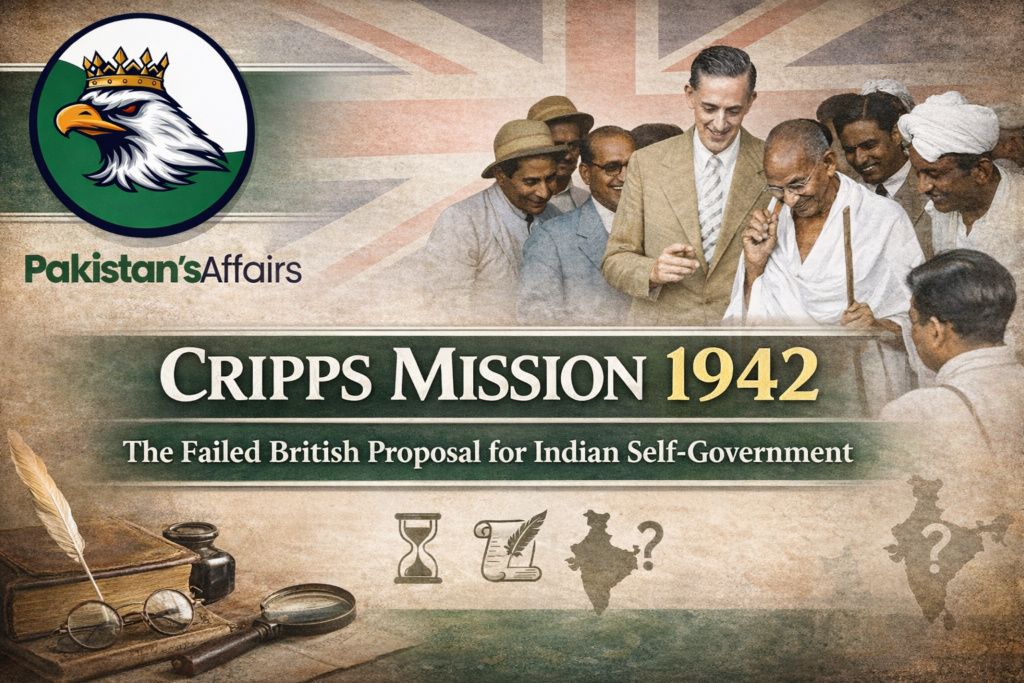
The mission failure further deepened Britain’s political crisis. Particularly, it widens the gap between the Indian National Congress and the All-India Muslim League (the two major political parties).
Original Insights & Paradoxes of Cripps Mission:
The Paradox of the “Post-Dated Cheque”: The offer was famously rejected by Mahatma Gandhi as a “post-dated cheque on a failing bank.” As Japan advanced in Southeast Asia, it also reflected Indian scepticism about British promises.
Partitioning Blueprint: The British explicitly admitted the possibility of partition for the first time. Provinces were given the option to “opt out” of a potential Indian Union. This was a significant break from the British-held “unity of India” idea.
Sabotage from within: Cripps represented liberal change, even if private communication wasn’t made public until decades later (1970). According to this letter, Secretary of State Leo Amery and Viceroy Linlithgow purposefully undermined his attempts. They said he made sure the expedition would fail.
The Real Motivator – International Pressure: The expedition was more an extreme pressure product than a gesture of British goodwill. On the other hand, China (Chiang Kai-shek) and the United States (President Roosevelt) both applied pressure to the British. This is due to the fact that both believed that defeating Japan required a stable and cooperative India.
| Stakeholder | Key Reason for Rejection |
| Indian National Congress | Demanded quick independence and a genuine role in India’s defences. |
| Muslim League | Objected since it did not specifically call for Pakistan to become an independent state. |
| Princely States | In a new constitutional system, they feared for their existence. |
| Dalit Leaders | Fearing a “Hindu Raj” for the future, the downtrodden classes found nothing new. |
Guys, I hope you are doing well! As you are aware, we are covering the series “History of Pakistan” these days: “Lahore Resolution | The Demand for Pakistan“. If you haven’t read it already, then read our previous article first! In our first attempt, we are trying to cover the historical period from the 1940s to 1947 (before independence).
Background of the Cripps Mission 1942:
In the early 1940s, the world had dramatically transformed into a new world order. This is due to the Second World War, which changed everything. When Japan’s swift military won in Southeast Asia, it brought the conflict perilously close to India’s frontiers. Further, this situation converted Burma into a terrifying battlefield. Therefore, the British administration became increasingly worried about India’s security day by day. Because there is potential for political unrest in India, and that means something.
Political parties in India stepped up their calls for independence during the same period. Furthermore, it’s notable that Quaid-e-Azam Muhammad Ali Jinnah was the leader of the All-India Muslim League at that time. Meanwhile, the All-India Muslim League persisted in the creation of a distinct Muslim state. That’s why the Indian National Congress quickly desired self-government in all of India.
The growing political divide between the Muslim League and Congress produced a difficult political atmosphere. The British government decided to dispatch a special mission to India to resolve these concerns and win Indian support for the war effort.
Arrival of the Cripps Mission 1942:
There was no better option than Sir Cripps for the British government. Mr Cripps was also serving as Lord Privy Seal in England at the same time. 90% historians believe that Sir Stafford Cripps led that historic journey to British-occupied India for a reason. On March 22, 1942, he finally arrived in Delhi with clear goals for negotiations.
Basically, it was a British constitutional settlement that was sent to India. Meanwhile, the British assumed that all the major Indian political groups would accept those objectives. In the end, Sir Cripps represented those objectives to the mission members on behalf of the British government.
Sir Stafford Cripps was not completely sure about the mission’s outcome and the ground realities of Indian politics. Anyway, he represented the mission’s objectives, especially to the Indian National Congress and the Muslim League. He was appointed to persuade Indian leaders to cooperate with Britain during the war. In simple terms, he wanted Indian leaders’ cooperation in exchange for promises of future self-governance.
Cripps Mission Members
Cripps held extensive meetings with prominent political leaders during his stay in India. These are some members who include:
- Jawaharlal Nehru
- Maulana Abul Kalam Azad
- Quaid-e-Azam Muhammad Ali Jinnah
- Sir Sikandar Hayat Khan
- A.K. Fazlul Haq
- Dr. B.R. Ambedkar
- V.D. Savarkar
- Tej Bahadur Sapru
Although the mission conveyed its message and also discussed its different angles with its members. Yet the mission’s proposed plans met with strong criticism from various political factions.
Proposals or The Cripps Mission Plan:
A series of constitutional proposals aimed at outlining India’s post-war political framework. The Cripps Mission 1942 represented these constitutional ideas to the major Indian parties. The main proposals include the following:
- Dominion Status After the War: The British government promised that India would be granted Dominion Status once the Second World War ended. This meant that India would have full internal autonomy and control over its external affairs. Meanwhile, it remains associated with the British Commonwealth under the Crown.
- Formation of a Constituent Assembly: After the war, a Constituent Assembly would be convened to draft India’s future constitution. Meanwhile, princely states would choose their own delegates. Further, the provincial legislatures would be able to elect members of this assembly using proportional representation.
- Right of Provinces to Opt Out: One of the most controversial proposals allowed provinces to opt out of the proposed Indian Union. Provinces that did not agree with the new constitution would have the right to remain separate. Even those provinces would be able to form their own political union. The Muslim League’s desire for Pakistan was centred on the likelihood. Meanwhile, this clause was subtly accepted in response to the Muslim League’s demand for Pakistan.
- Interim Government During the War: An interim government composed of representatives from major Indian political parties was proposed to function during the war. However, crucial powers such as defence and external affairs would remain under the control of the British Viceroy.
Reaction of Indian Political Leaders:
The proposals of the Cripps Mission received mixed but largely negative responses from Indian political leaders.
Response of the Muslim League
Quaid-e-Azam Muhammad Ali Jinnah expressed serious concerns about the Muslims of United India. Furthermore, he expressed that these proposals were unsatisfactory for the future of Muslims. He also stated that:
“Accepting the proposals in their existing form could endanger Muslims political interests”.
Although the proposals indirectly recognised the possibility of partition through the provision allowing provinces to opt out of the union. Yet Jinnah believed that the demand for Pakistan had not been clearly acknowledged.
He insisted that the principle of Pakistan should be recognised explicitly rather than being presented in vague or indirect terms.
Response of the Indian National Congress
The Indian National Congress also rejected the proposal, but for different reasons. The Congress leaders demanded an immediate transfer of power. They also stated that:
“Until after the war, they did not accept the postponement of independence ideas”.
Additionally, Congress strongly opposed the clause that allowed provinces to separate from the union. Congress leaders said it threatened the concept of a united India.
Why the Cripps Mission of 1942 Failed Politically?
Due to several political and constitutional factors, 1942’s Cripps Mission ultimately failed.
- Lack of Immediate Independence: The proposals did not offer immediate self-government. Instead, they promised Dominion Status only after the war ended. Both the Congress and the Muslim League viewed this as an attempt to delay independence.
- Disagreements Between Political Parties: The big ideological differences between the Congress and the Muslim League made that decision far more difficult. So, both parties were unable to reach a common constitutional arrangement. Further, the Congress wanted a united India. But the Muslim League insisted on recognition of Pakistan’s demands.
- Vague Constitutional Guarantees: Many Indian leaders believed that those proposals lacked clear guarantees regarding power transfers. Indian leaders also doubted future constitutional arrangements.
- British Control During the War: During the war, these plans allowed the British government to retain control over defence and foreign affairs. Further, it also reduced Indian confidence in the proposal.
- Mutual Distrust: Political distrust between the Indian leaders and the British government also contributed to the failure of the negotiations.
Historical Significance & its Impact on the Pakistan movement:
Although the Cripps Mission did not succeed in order to achieve its immediate objectives. Yet it had significant long-term consequences for the united India’s political future.
This mission confirmed one thing: India would become a sovereign nation someday. This is because it was the British government’s first formal acknowledgement at that time. Further, it also indirectly acknowledged the possibility of political division inside India. Consequently, this mission played a very significant role in 1947’s establishment of Pakistan.
Moreover, the mission’s failure also strengthened major Indian political parties in the United India. Therefore, these political parties also intensified the Indian political movement’s determination and struggle for independence.
An Expert Analysis – Cripps Mission:
Cripps Mission 1942’s historical examination reveals a complicated interplay. This interplay occurred between hardening Indian nationalist views and internal British political scheming. Also, wartime hopelessness played a crucial role in this complicated scenario.
In my opinion:
I see this expedition as a turning point that significantly changed United India’s independence. But somehow, rather than just a failed negotiation, this mission led British-occupied India to a big partition. Basically, the British’s first attempt at partition backfired.
Final Thoughts:
British strategy vs Indian expectations: Although the Cripps Mission of 1942 was a crucial one. Yet during the Second World War, the British government made a failed attempt in order to resolve the constitutional crisis in India. Meanwhile, with the future independence promises, the mission proposals aimed to balance the wartime needs. So, they ultimately satisfied neither the Indian National Congress nor the Muslim League.
Indirect acceptance of partition: The mission’s failure highlighted India’s deep political divisions. The team also emphasised how urgent it is to decide the subcontinent’s constitutional destiny. Meanwhile, the Cripps Mission is nevertheless seen as a significant turning point in the historical process. Despite its flaws, it ultimately resulted in the end of British rule. Additionally, the mission promoted the formation of sovereign states in South Asia.
References:
Wikipedia – Cripps Mission
Britannica – Cripps Mission
Book: The Cripps Mission by Sir Reginald Coupland

1 Comment