

Ravi River – An Introduction and Background Story:
The Ravi River is a lifeline for millions of people, far more than a geographical feature at all. For a long time, this river has been interlinked with Punjab’s culture and its historical heritage. For centuries, the Ravi River has also been a part of a strange history. Many historians count it as the backbone of Punjab’s agricultural lands.
Basically, this historic river flows on a long path from the breathtaking Himalayan landscapes to the rich Punjabi plains. This river has its own way, whether it is between India and Pakistan. Although the Ravi River has witnessed many civilisations that have come and gone over a long period. Yet, many secrets and folk tales are directly or indirectly connected to this historic river. That’s why this river has influenced millions of people’s lives and fostered civilisations.
We will examine the geographical paths, length, historical significance and the origin of the Ravi River. In this article, we will also examine its long-term effects on the area. So, please like and share our content if you really enjoy it, guys! Because we truly value your support.
Ravi River Origin – From the Himalayas to the Plains:
In India, the magnificent Himalayas of Himachal Pradesh are the source of the great Ravi River. The river is located at an elevation of around 14,000 feet in height above sea level. Furthermore, it rises close to the Chamba region’s Rohtang Pass.
Before veering southwest toward Punjab’s plains from its mountainous origins, this river travels northwest. This is the region where the Chenab River travels through Lahore and the neighbouring rural areas when entering Pakistan.
Himalayan origin glacier meltwater guarantees consistent flow. Particularly in the summer season, which greatly aids downstream agriculture and irrigation.
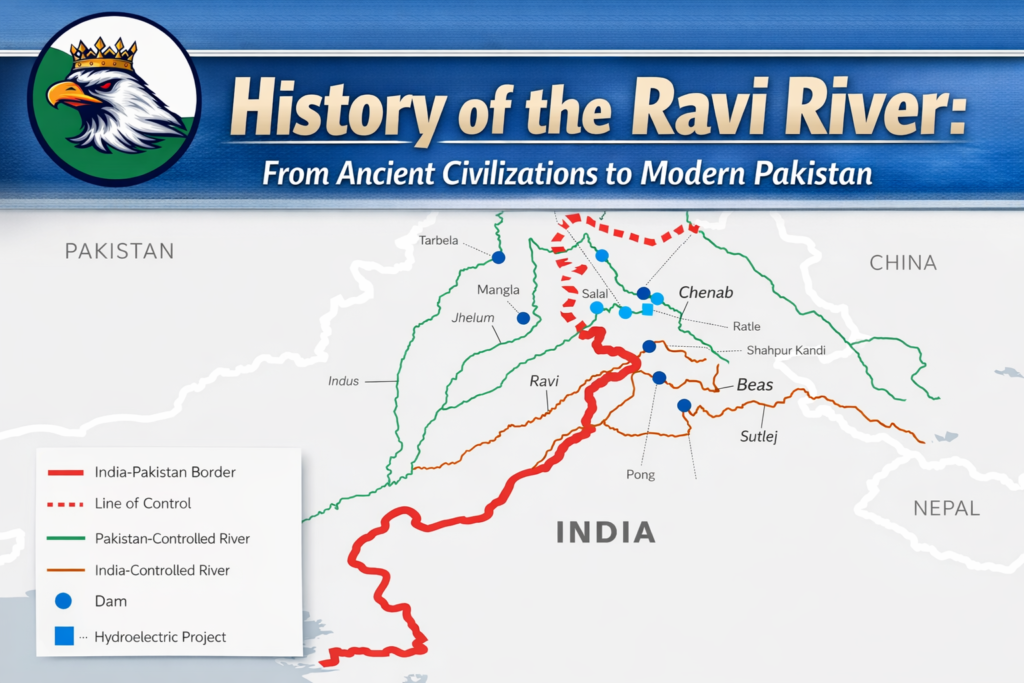
Ravi River Length and Course:
The total length of the Ravi River is approximately 720 kilometres (450 miles) overall. This also means that its influence on Punjab has been profound over the centuries. Especially when it is compared with other rivers in the Indus system.
The river passes through:
- Chamba Valley (India)
- Indian Punjab
- Lahore Division (Pakistan)
- Southern Punjab plains
Eventually, the Ravi joins the Chenab River (another major river in Punjab). Eventually, the Ravi joins the Chenab River (another major river in Punjab). It merges with other rivers before its water flows into the Indus River.
Guys, if you love our content “Pakistan’s Affairs“, please like and share! Because your support really matters to us.
Basically, Panj-Aab means “Land of Five Waters.” So, the Ravi is one of the five rivers that gave Punjab its real name.
Ravi River Map and Geographical Importance:
A glance at the Ravi River map reveals its strategic and political importance. Historically, the river served as a natural boundary for Punjab. It also served as a defensive line for many cities in various eras.
Although Ravi was also divided after the 1947 Partition. Yet in certain stretches, it became part of the international boundary between India and Pakistan. Later on, the waters of the Ravi were allocated to India along with the Beas and the Sutlej rivers. Meanwhile, Pakistan owned the rights to the Indus, Jhelum, and Chenab rivers. This all happened under the Indus Water 1960 Treaty.
This agreement changed irrigation practices in Pakistan’s Punjab. But the agreement also dramatically changed the region’s water management system.
Ancient History – The River of Civilisations:
According to ancient times, the Ravi was known as Iravati in Sanskrit texts. Basically, it played a role in the development of the early Vedic civilisation in Indian history. Later on, it also supported settlements during the Mauryan and Gupta periods.
Although the Indus Civilisation Valley’s main hubs were situated along the Indus and its western tributaries. Yet small communities and trade routes have also been found in the Ravi’s basin throughout history.
Ravi’s riverbanks provide fertile soil for huge agricultural fields. It not only enables agricultural prosperity for the people of Punjab but also provides population growth.
Medieval and Mughal Era Significance:
Ravi became closely associated with Punjab’s cultural and political centres during the medieval period.
The historic city of Lahore has always flourished along its banks. This is because Lahore served as the Mughal Empire’s capital city during the Mughal era. So basically, the river played a crucial role in supplying water and enhancing trade routes. It also supported the gardens that were located near it.
The Shalimar Gardens were designed with advanced hydraulic systems. This magnificent Mughal garden was specially designed in order to be connected to the river.
The river was not only a waterway. But it symbolised prosperity and imperial grandeur over the years.
Colonial Period and Canal System Development:
The Ravi became the focal point of a vast canal irrigation system during British colonial control. The British created one of the world’s most advanced canal networks, turning desert regions into fruitful agricultural areas.
Built in the 19th century, the Upper Bari Doab Canal transformed agriculture in central Punjab. This is because the canal was drawing water from the Ravi.
Punjab’s agricultural character, which persists to this day, was established by this canal colonisation.
Ravi River After Partition (1947):
Ravi’s geopolitical significance was altered by the 1947 partition of British India. Control over river waters became crucial for both economic survival and national security when boundaries were established.
Water-sharing problems between India and Pakistan were settled according to the 1960’s Indus Water Treaty. The World Bank was mediating this problem. According to the treaty, Pakistan had to build connection canals to adjust and reroute water from western rivers. But India had the right to maintain control over the Ravi’s waters.
Despite political differences, communities on both sides of the border still support Ravi.
Environmental Challenges and Modern Concerns:
Ravi River has faced significant environmental challenges in recent decades:
- Industrial pollution
- Urban sewage discharge
- Reduced natural flow due to upstream dams
- Climate change impacts
The river has suffered from declining water quality near Lahore. Meanwhile, both countries’ efforts are underway in order to restore ecological balance and protect biodiversity. Moreover, both countries do their own job to improve wastewater treatment especially.
The river’s revival is not only essential for agriculture. But it is also a showstopper issue for environmental sustainability.
Cultural and Symbolic Importance:
In Punjabi literature and tradition, the ravi holds special significance. It represents continuity, resilience, love and separation.
Poets and historians have long recorded the Ravi’s tranquil flow and lush banks. But it continues to be an emotional milestone for the people of Punjab.
It is not simply a river, yet it is a dynamic phase of local identity.
Why the Ravi River Still Matters Today:
Ravi continues to play a critical role despite modernisation and urban expansion:
- Irrigation and agriculture
- Water supply systems
- Regional ecology
- Cultural heritage
There is no doubt that Pakistan and India not only face increasing water scarcity problems. But they are also facing change and population growth issues these days. On the other hand, sustainable management of rivers like the Ravi is more important than ever.
Concluding Thoughts:
The Ravi River’s journey from the Himalayas to the plains of Punjab not only tells the story of civilisations. But they also tell us about ancient empires and their resilience over the period. Furthermore, its divisions and waters nourished generations and shaped political destinies. This river also supported many cities for centuries.
Before understanding the Ravi River’s origins, the Ravi River length, the Ravi River map and its historical evolution. Understanding the insight into Punjab’s past and present with a broad narrative.
Although it has been rightly called the lifeline of Punjab for centuries. Yet its legacy continues to flow with the same quiet strength.
FAQ’s:
Where does River Ravi start and end?
The Ravi River is an important transboundary river that flows through both India and Pakistan. This historic river originates in the Himalayas and eventually joins the Chenab River. It then falls into the Indus River and finally becomes a part of the Indian Ocean.
Has India stopped Ravi Water from flowing to Pakistan?
India has tried its best to prevent excess water from the Ravi River from entering Pakistan. Over time, India constructed many dams on the river in order to stop the river’s water. But the reality is that the Indus Water Treaty binds India to not fully stop the river water.
What is special about the Ravi River?
The Ravi River has its own place among Punjab’s other five rivers. For centuries, its name reverberated throughout Punjabi literature. Ravi’s banks have seen love and grief. That’s why its waters have flowed throughout history.
What is the old name of the River Ravi?
Indians referred to the Ravi River as Purushni or Irawati during the Vedic era. But Yaska (Nirukta 9.26) claims that the Ravi River in Punjab, “or a portion of it,” was the site where the Battle of the Ten Kings happened, and this was the site he indicated.
References:
Wikipedia – Ravi River
Baritannica – Ravi-River
